





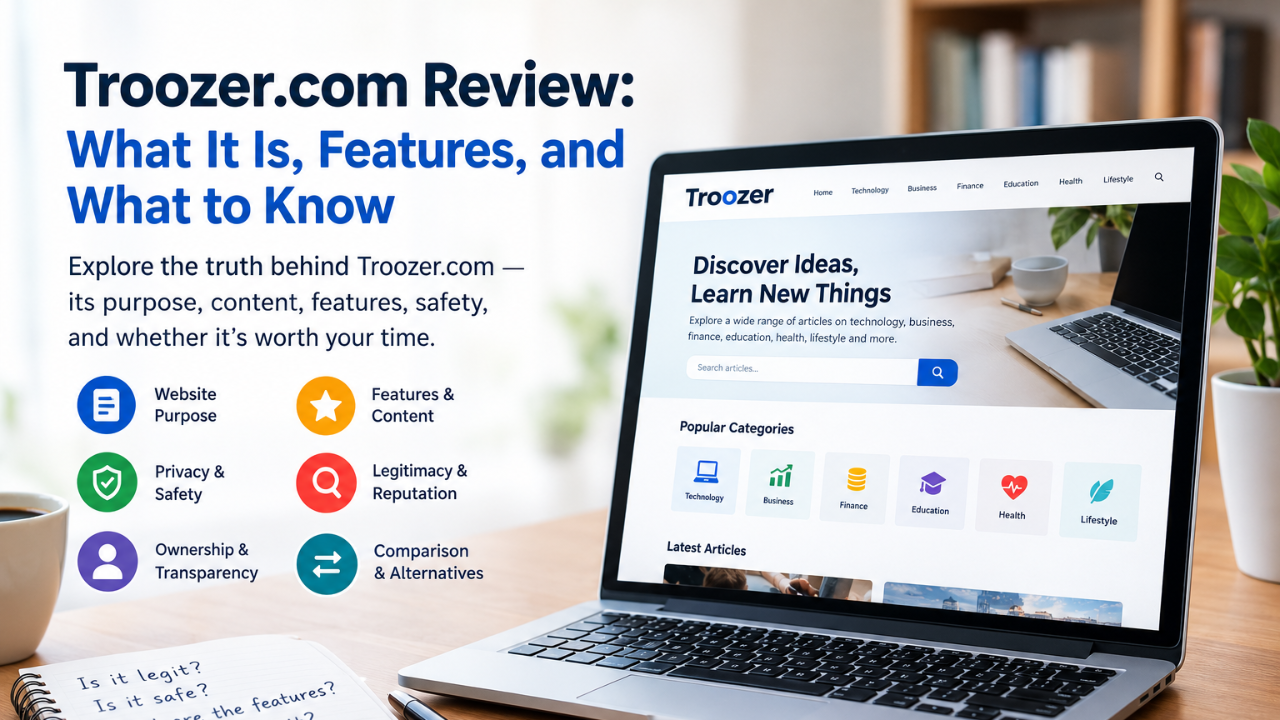
When an unfamiliar website appears in search results, it is natural to wonder whether it deserves your attention. Troozer.com has attracted interest because different online articles describe it in different ways. Some present it as a digital publishing website, while others associate it with AI tools, shopping services, or productivity features.
So, what does Troozer.com actually do? Available information points mainly toward a multi-category digital publishing website that presents articles on subjects such as technology, business, finance, education, and lifestyle. However, conflicting descriptions make it important to separate verified information from speculation. Recent online reviews also raise questions about transparency and content quality. These concerns deserve careful examination rather than quick conclusions.
This guide explores the website’s apparent purpose, domain history, published content, and online reputation. It also explains practical ways to assess its privacy and security. Whether you discovered Troozer.com through Google or encountered a link elsewhere, this review will help you make a more informed decision.
The Story Behind the Troozer.com Name
Troozer.com is an online domain that has become the subject of several different descriptions. Its current public presentation is consistent with a general-interest publishing website. Readers can explore informational material across multiple subjects rather than use a clearly established shopping checkout or dedicated software dashboard. This distinction matters because a website’s name alone cannot explain its purpose. Visitors should examine its actual pages and functions before accepting descriptions found elsewhere.
The confusion comes from the variety of claims published about the domain. Some articles describe Troozer.com as an AI workspace, shopping platform, or productivity service. Other reviews identify it as a digital magazine. These descriptions cannot all be accepted without supporting evidence. A website that publishes articles about technology does not automatically provide technology services. Similarly, discussing shopping or artificial intelligence does not make a site an online store or AI application.
How Troozer.com Is Described Across the Internet
Search results offer a useful starting point, but they do not always provide reliable answers. Some articles repeat similar claims without linking to official documentation or demonstrating the features they describe. This can make an unfamiliar website appear more established than the available evidence supports. Readers should compare independent sources and give greater weight to claims supported by observable functions, credible records, and direct documentation.
Why the Exact Website Address Matters
The domain name matters because similar names can refer to unrelated services. Before trusting a link, check that the address is spelled correctly and uses the intended domain. Look at the destination before entering information or downloading anything. This simple habit helps prevent confusion between legitimate websites, misleading copies, and unrelated services with similar names.
What the Website’s Published Material Reveals
The most useful way to understand Troozer.com is to examine its publishing structure. Available descriptions identify it as a multi-topic online publication covering subjects such as business, technology, finance, education, health, and lifestyle. The exact range of categories and the quality of individual articles should be confirmed against the live website. Its publishing format suggests that visitors may use it to explore general information without committing to one specialist subject.
A broad subject range can make a website convenient for casual reading. Someone researching a new technology trend, for example, might also find articles about business or everyday life. However, broad coverage does not guarantee depth or accuracy. Readers should examine each article separately, paying attention to its author, publication date, supporting references, and factual claims. These details offer a better measure of usefulness than a polished layout alone.
The Subjects and Topics Readers May Encounter
Technology, business, finance, education, and lifestyle are among the subject areas associated with Troozer.com in public descriptions. A broad publishing model can introduce readers to ideas they have not explored before. It may also help people understand basic terms before moving to more specialized resources. Still, the presence of an article on a subject does not prove that the publisher has professional expertise in that field.
How Articles Are Organized and Presented
A typical digital publication organizes material through article pages, category links, headings, and navigation menus. These elements help visitors move between subjects and locate relevant information. Readers should check whether the website identifies its authors, displays dates, links to original sources, and explains its editorial process. Clear presentation improves usability, but reliable evidence remains essential for judging the content itself.
Is the Content Designed for Casual Reading or Expert Research?
General-interest articles often work best as introductions to unfamiliar topics. They can explain basic concepts and point readers toward questions worth investigating. Expert research requires more: detailed evidence, qualified authors, transparent methods, and references that readers can verify. For important medical, legal, or financial questions, use Troozer.com only as a possible starting point until its claims have been checked against authoritative sources.
Separating Real Features From Online Claims
One major question surrounding Troozer.com concerns its supposed functionality. Different websites have associated the domain with AI services, shopping tools, productivity systems, and other digital products. However, descriptions alone do not establish that these features exist. A trustworthy assessment needs evidence such as a working interface, official documentation, published terms, or a clearly demonstrated service. Until then, unsupported claims should remain unconfirmed.
The distinction is straightforward: content about a service is not the same as the service itself. A publishing website might explain how AI works without offering an AI application. It might discuss online shopping without selling products. Readers should therefore assess the site’s visible functions rather than assume that every feature mentioned in search results belongs to Troozer.com.
What Evidence Would Confirm an AI Service?
A genuine AI service usually provides a clear way to interact with its system. Depending on its purpose, this could include a prompt interface, a document analysis function, or a tool that generates useful output. Official instructions and clear explanations of its capabilities would add credibility. Current public descriptions do not provide sufficient evidence to confidently classify Troozer.com as a dedicated AI productivity platform.
How to Recognize a Genuine Online Marketplace
An online marketplace generally displays products or services, seller details, pricing, and a process for placing orders. Buyers also need access to relevant payment, shipping, cancellation, and return information. Without these elements, describing a website as a shopping marketplace may be misleading. Available descriptions of Troozer.com more strongly support a publishing model than a conventional e-commerce business.
Why Repeated Online Descriptions Can Be Misleading
Several websites repeating a statement does not automatically make it true. They may rely on one another rather than consult the original source. This creates an information loop in which an unsupported claim gradually appears established. To avoid this problem, check whether a statement links to official evidence and whether independent sources reach the same conclusion through their own research.
Troozer.com’s Digital Footprint and Website History
Public domain records provide some background about Troozer.com. Information reported by IPAddress.com lists March 15, 2013, as the domain registration date and identifies Wild West Domains, LLC, as the registrar. The same source reports HTTPS support and Cloudflare infrastructure. These details describe aspects of the domain and its technical setup, but they do not establish who currently operates the website or how trustworthy its content is.
A domain’s age must not be confused with the age of its present business or editorial operation. Domains can change owners, hosting providers, design, and purpose over time. Archived pages may help researchers understand these changes, while registration records can provide useful context. Neither source alone proves a continuous history of the current publication. The most reliable assessment combines historical records with current website evidence.
Domain Registration Versus the Age of a Website
The registration date tells readers when a domain record began under the reported registration history. It does not prove that today’s website has operated unchanged since that date. A domain might have been parked, sold, repurposed, or developed by a different operator. Therefore, domain age should be treated as background information rather than a trust score.
What Archived Pages Can Tell Readers
Internet archives can preserve snapshots of websites from earlier dates. Researchers may compare those snapshots to see how page layouts, descriptions, and publishing activities changed. However, archives do not capture every page or every moment. Missing snapshots are not proof that a website did not exist, and an old screenshot cannot establish the site’s current practices.
The Importance of Independent Mentions and References
Independent references can help establish whether a website has a meaningful public presence. Stronger evidence might include credible reporting, identifiable partnerships, or direct references from reputable organizations. Promotional articles and repeated descriptions provide less certainty when they lack independent verification. Readers should examine the source of each claim instead of counting how many pages repeat it.
Can Readers Establish Who Runs Troozer.com?
Ownership transparency is an important part of evaluating an online publication. Readers should look for an identifiable operator, a working contact page, an editorial policy, and clear legal information. These details help explain who is responsible for published material and where readers can report errors. Available third-party descriptions have raised questions about Troozer.com’s ownership, so its current operator should not be named without reliable confirmation.
Limited ownership information does not automatically prove fraud. Some legitimate website owners use domain privacy services to protect their personal details. However, readers may find it harder to assess accountability when no responsible organization or editorial team can be independently verified. The key question is whether the website provides enough reliable information for users to understand who operates it and how to make contact.
Looking for Company Details and Accountable Contacts
Check the website’s About, Contact, Terms of Service, and editorial pages. Look for consistent business names, working email addresses, and clear explanations of the site’s purpose. If the website lists authors or editors, examine whether their identities and credentials can be confirmed elsewhere. A contact form alone does not establish ownership, but a transparent and responsive organization offers stronger accountability.
What Public Records Can and Cannot Prove
Domain registration records, business registries, and archived pages can reveal useful details. Yet each source has limits. A registrar manages domain registration; it is not necessarily the website’s owner. A hosting location does not prove where the operator lives or runs the business. Responsible research separates technical facts from assumptions about identity, location, and ownership.
Why Ownership Transparency Affects Reader Confidence
Clear ownership gives readers a path to seek corrections, raise complaints, and understand editorial responsibility. It also helps advertisers and contributors assess whom they would be dealing with. When ownership remains unclear, confidence should depend on other verifiable evidence rather than branding or promotional language. Readers should be especially careful before entering into a commercial agreement with an unfamiliar operator.
How to Judge the Quality of Troozer.com’s Articles
Every article deserves its own assessment. A website may publish a useful explanation on one subject and a weak article on another. Readers should look for named authors, clear dates, reliable references, and claims that can be checked independently. Articles that explain their evidence make it easier to separate established facts from personal interpretation or advertising.
This approach is especially important when content covers high-impact topics. A financial article might omit risks, while a health article might rely on outdated advice. Legal guidance may also depend on the state where a reader lives. For American readers, the best approach is to confirm important claims through recognized government agencies, qualified professionals, or original research before taking action.
Check the Author, Publication Date, and Supporting Sources
An author’s background can help readers judge whether the writer understands the subject. Publication and update dates matter because rules, technology, prices, and research can change. References should lead to sources that actually support the article’s claims. If an article offers no author details or verifiable evidence, treat it as introductory material rather than an authoritative source.
Identify Unsupported Statements and Promotional Language
Be cautious when an article promises guaranteed results, makes sweeping claims, or urges immediate action without explaining why. Promotional wording may serve a commercial purpose rather than help readers understand a subject. Look for concrete evidence, reasonable qualifications, and a clear distinction between fact and opinion. A confident tone cannot replace proof.
Verify High-Stakes Information Through Authoritative Sources
Medical questions should be checked with qualified health professionals and trusted health organizations. Legal questions may require state-specific government resources or advice from a licensed attorney. Financial decisions deserve careful research and a clear understanding of risk. General publishing websites can introduce a topic, but they should not be the final authority for decisions that could affect someone’s health, rights, or savings.
Privacy, Security, and Responsible Browsing
Privacy and security are separate issues when evaluating an unfamiliar website. Troozer.com has been reported to support HTTPS, which helps encrypt information moving between a browser and the website. However, HTTPS does not prove that the operator is trustworthy or that every page is safe. Readers should consider technical protections alongside transparency, content quality, and the information a website requests.
The Federal Trade Commission explains that websites may use cookies, tracking technologies, and other tools to collect information about visitors. The exact practices used by Troozer.com should be checked against its current privacy policy rather than assumed.
What HTTPS Does—and What It Does Not Guarantee
HTTPS helps protect information while it travels between your browser and a website. It can make it harder for outsiders to intercept that information in transit. However, it does not verify the accuracy of articles, reveal the operator’s intentions, or guarantee protection from every online threat. Treat HTTPS as a basic security measure, not a complete trust certificate.
Reviewing Cookies, Privacy Notices, and Data Requests
Read the privacy policy to understand what information the website may collect and how it may use that data. Look for explanations of cookies, analytics, advertising, data sharing, and retention. Be cautious if a page requests sensitive details without a clear reason. Avoid providing financial information or personal documents unless the service and the need for those details have been independently verified.
Warning Signs That Deserve Further Investigation
Unexpected downloads, repeated redirects, aggressive pop-ups, and unexplained payment requests deserve attention on any unfamiliar website. Never install software simply because a page tells you that your device has a problem. Close suspicious pages and use your browser’s built-in security features. These are general online safety precautions, not claims that Troozer.com has demonstrated each behavior.
What Troozer.com May Be Useful For—and Where It Falls Short
A multi-topic publishing website may help readers explore subjects without visiting several different publications. If Troozer.com provides clear, accurate, and well-supported articles, it could serve as a starting point for general learning. Its broad subject range may appeal to readers who enjoy discovering new ideas. Still, the value of any article depends on its evidence, relevance, and quality.
The main limitation is uncertainty. Conflicting online descriptions and questions about ownership can make the website harder to evaluate. Readers should not assume that every article is unreliable, but they should not treat every claim as established fact either. A careful approach means judging each page on its merits and checking important information elsewhere.
Situations Where a General Publishing Website Can Help
Readers exploring a new subject may benefit from introductory articles that explain unfamiliar terms in plain English. A general publication can also help people identify questions for further research. For example, someone learning about online privacy might begin with an introductory guide before consulting official resources. This works best when the article provides useful references and avoids exaggerated claims.
When Readers Should Choose a Specialist Resource
Specialist resources are usually more appropriate when a decision carries significant consequences. Medical treatment, legal disputes, investments, and cybersecurity incidents require careful evidence and often professional advice. American readers can consult government agencies, established research organizations, and qualified professionals. General-interest content may provide background, but it should not replace expert guidance.
Questions to Resolve Before a Business Relationship
Advertisers and contributors need more than a website address before committing money or work. They should establish who operates the publication, request written commercial terms, and verify any audience or traffic figures. They should also review editorial standards and understand how sponsored material will be disclosed. If the operator cannot provide convincing evidence, delaying the agreement is a sensible decision.
Troozer.com Compared With Established Information Sources
Troozer.com should be compared with other resources according to its apparent role as a publisher. Established publications may offer named journalists, documented editorial processes, and correction policies. Specialist websites can provide deeper subject knowledge, while official government pages often provide primary information about regulations and public services. These differences matter more than a website’s visual design or the number of subjects it covers.
Search engines and AI services serve different purposes. Search engines help people discover pages across the web, while AI tools may generate responses or assist with specific tasks. A publishing website primarily provides material for readers to consume. Available evidence does not clearly establish Troozer.com as a dedicated AI workspace or conventional shopping marketplace, so those functions should not be assumed.
| Resource type | Main purpose | Best approach |
|---|---|---|
| Troozer.com | Appears to focus on general-interest publishing | Check individual articles and verify important claims |
| Specialist publications | Provide deeper coverage of selected subjects | Review author expertise and supporting evidence |
| Government websites | Publish official information and public guidance | Use relevant agencies for authoritative information |
| Search engines | Help users discover information across websites | Compare sources instead of trusting one result |
| AI tools | Provide interactive assistance or generated responses | Verify important outputs against reliable sources |
General Digital Publications and Specialist Publishers
General publications offer variety, while specialist publishers may offer greater depth in a particular field. Neither format guarantees accuracy. Readers should compare the quality of the evidence, author expertise, publication dates, and editorial accountability. The best resource is the one that answers the question with reliable, relevant information.
Search Engines and Primary Sources
Search engines make research faster, but search ranking is not a guarantee of factual accuracy. A page can appear prominently without providing strong evidence. Primary sources, such as official documents, original studies, and government guidance, help readers check claims directly. Comparing these sources can prevent misunderstandings caused by repeated or incomplete descriptions.
Choosing the Right Source for Your Research Needs
Start by identifying the purpose of your research. Casual reading may require a straightforward introduction, while an important decision calls for stronger evidence. Check the author’s qualifications, confirm the publication date, and follow the references. If the claims cannot be verified, seek another source before acting on them.
A Practical Checklist Before Relying on Troozer.com
A few simple checks can help readers assess Troozer.com without jumping to conclusions. Confirm that you have reached the correct domain, review the site’s published policies, and look for identifiable authors and supporting references. Check whether independent sources confirm important claims. If the website offers a service or commercial opportunity, request clear documentation before paying or sharing sensitive information.
Consider a reader who finds an article explaining a new financial product. The article may provide a helpful introduction, but the reader should also examine the product’s official documentation, fees, risks, and regulatory information. If those details conflict with the article, the original documents deserve closer attention. This example illustrates why independent verification matters more than polished writing or confident claims.
FAQs
What does Troozer.com appear to do?
Available public descriptions identify Troozer.com mainly as a multi-category digital publishing website. It appears to focus on informational articles rather than a clearly established shopping or software service. Readers should check the live website to confirm its current content and functions.
Why do online articles describe Troozer.com differently?
Different descriptions may come from outdated information, unsupported assumptions, or articles that repeat claims from other websites. The number of pages making a statement does not prove that the statement is correct. Direct evidence and independent verification offer a stronger basis for judgment.
Can the owner of Troozer.com be identified?
Public descriptions raise questions about the website’s ownership and accountability. A reliable assessment requires current records or direct disclosures that identify the responsible operator. Domain registration details alone do not establish who runs the present website.
Does Troozer.com provide AI or shopping services?
Available evidence more strongly supports its classification as a publishing website. Claims about AI functionality or marketplace services should remain unconfirmed unless the site demonstrates those features through working tools, official documentation, or clear transaction facilities.
Should readers rely on Troozer.com for important information?
Readers can assess its articles individually, but important claims should be checked against authoritative sources. This is particularly important for health, legal, and financial topics. Clear references and qualified authors can help establish credibility.
What should visitors check before sharing personal information?
Review the privacy policy, verify the domain, and understand why the website needs the information. Avoid submitting sensitive details when the purpose or operator remains unclear. These precautions are useful when visiting any unfamiliar online publication.
Conclusion
Troozer.com is best understood, based on the available descriptions, as a website focused on publishing articles across several subjects. Its apparent purpose is clearer than some conflicting online claims suggest. However, questions about ownership, editorial accountability, and the reliability of individual articles deserve careful attention. A domain’s age or HTTPS support cannot answer every question about trustworthiness.